mardi 24 novembre 2009

Android augmenté chez Bouygues Telecom


Basé sur la boussole du terminal, l’application réagit selon votre position géographique, elle combine laréalité augmentée et les informations des établissements, en prenant pleinement partie du matériel disponible sur les smartphones Android.
Trois modes disponibles selon l’orientation que vous donnez à votre terminal :
  • Verticale : Mode listing des catégories
  • Paysage : Mode caméra
  • Horizontale : Mode navigation GPS
Ici Info va vous permettre de trouver rapidement selon plusieurs catégories et en fonction de votre emplacement géographique, différentes informations des établissements disponibles de votre entourage.
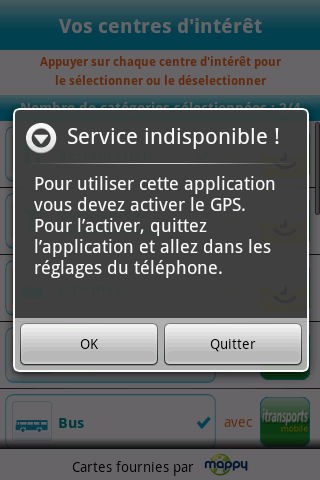
Pour utiliser l’application vous aurez besoin de valider le « contrat de licence utilisateur« , autoriser l’application « Ici Info » à utiliser vos données de localisation et avoir activé le GPS dans les réglages duterminal.
ici-info-android-france-01ici-info-android-france-02ici-info-android-france-06
Voici la liste exhaustive des catégories disponibles :
  • Restauration
  • Bars, Cafés, Discothèques
  • Cinémas
  • Métro/RER/Tram
  • Bus
  • Trains, Transiliens
  • Vélos
  • Toilettes publiques
  • Hôtels
  • Pharmacies, Hôpitaux
  • Presse, Bureaux de tabac
  • Banques
  • Fleuristes
  • Taxis
  • Clubs Bouygues Telecom
  • Parking
  • Stations Services
Lors du premier lancement de l’application, un guide vous propose un didacticiel pas-à-pas vous détaillant les manipulations à effectuer pour utiliser l’application.
ici-info-android-france-03ici-info-android-france-04

Au lancement de l’application, vous tombez directement sur la liste des catégories, l’application limite la sélection de celle-ci à 4 maximums en même temps.
ici-info-android-france-07
Une fois sélectionnée il vous suffit de basculer le terminal à la verticale comme si vous vouliez prendre une photo.
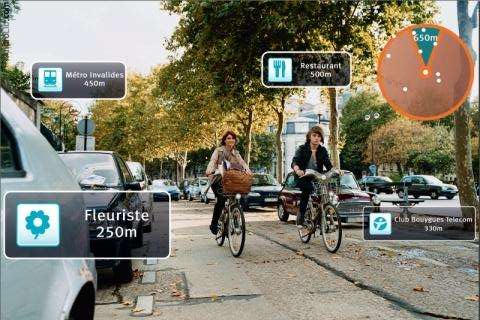
L’application passe en mode caméra et vous propose en réalité augmentée les différents points d’informations trouvés selon votre lieu.
Dans notre test nous avions sélectionné la « Restauration » et l’application nous a affiché les différents restaurants dans un périmètre base sur notre position géographique, une fois que nous avons localisé un restaurant vous avez la possibilité de cliquer sur le cadre du restaurant.
ici-info-android-france-11
L’application vous affiche une fiche complète de l’établissement et vous propose 3 alternatives :
  • la première vous permet de visiter le site de l’établissement
  • la deuxième consiste a vous mettre en relation avec l’établissement en composant le numéro de téléphone de celui-ci
  • la troisième option fait basculer l’application en mode navigation GPS.
Les informations sont tirées des différents services disponibles sur Internet.
  • PagesJaunes
  • BeTomorrow
  • iTransports Mobile
  • Bouygues Telecom
Le tout positionné sur les cartes fournies par le célèbre site de cartographie Mappy.fr.
Une vidéo que nous avons réalisé pour que vous puissiez vous faire une rapide idée du fonctionnement de l’application arrivera plus tard dans la soirée.
Quelques points faibles que nous aurions aimé voir (peu être dans une prochain version) sur la notion deréseautage que nous pouvons dissocier en 3 parties :
  • Pouvoir donner ou consulter les avis sur une fiche d’un établissement
  • Pouvoir partager une fiche d’un établissement (via facebook, twitter, etc.)
  • Pouvoir ajouter une fiche directement en rendez-vous sur un agenda Google
L’application est disponible gratuitement sur Android-Market mais ne fonctionne que pour les clients Bouygues Telecom.
ici-info-android-france-10
Ici Info
ici-info-android-france-09
Même s’il est clair que la technologie employée n’est pas à mettre au crédit de Bouygues Telecom qui surf sur la vague de la réalité augmentée, on ne peut que constater l’effort mis sur la vulgarisation, la prise en main est quasi immédiate.

lundi 23 novembre 2009

CODE DES MARCHES PUBLICS Projets de seuils applicables au 1er janvier 2010


POUVOIRS ADJUDICATEURS


Fournitures et services :
- Etat : article 26 II 1° 125 000 €
- Collectivités territoriales : article 26 II 2°  193 000 €
- Fournitures domaine de la défense : article 26 II 3° 193 000 €
- Services Recherche et développement : article 26 II 4° 193 000 €
Travaux :
- Libre choix des procédures : article 26 II 5  < 4 845 000 €
- Appel d’offres (ou recours aux procédures des articles 35 à 38) : article 26 IV  > 4 845 000 €


ENTITES ADJUDICATRICES


Fournitures et services : article 144 III a) 387 000 €
Travaux : article 144 III a) 4 845 000 €

dimanche 22 novembre 2009

ENT will be soon 50! Sort of , PLATO (hi)story....

Quick: Jump back in time to 1974. In a Harvard dormitory, Bill Gates, future co-founder of Microsoft, is goofing off playing poker and pinball. Over in India, Steve Jobs, future co-founder of Apple, has shaved his head and is wandering around seeking enlightenment. Out in Hawaii, Steve Case, future co-founder and head of AOL Time Warner, is busy writing album reviews for his Honolulu high school newspaper. While these future billionaire CEOs of Internet-industry behemoths are busy enjoying their last teenage years, at a university town in Illinois the 'Net has already arrived. Indeed: it's in full swing! Out here in the middle of cornfield country, there's a rich, vibrant online community of teachers, professors, hackers, slackers, pranksters, and software and hardware engineers thriving on email, chat rooms, instant messaging, addictive multiplayer games, multimedia, news, movie reviews, and message forums on everything from art, science, and literature, to sex, drugs, and rock and roll. How can this be?
[Caption: On PLATO, everyone knew you were a dog.]

Welcome to PLATO.
The PLATO system, started way back in 1960, was developed as a technological solution to delivering individualized instruction, in thousands of subjects from algebra to zoology, to students in schools and universities across the nation. As the system grew and evolved, it became, pretty much by accident, the first major online community, in the current sense of the term. In the early 1970s, people lucky enough to be exposed to the system discovered it offered a radically new way of understanding what computers could be used for: computers weren't just about number-crunching (and delivering individualized instruction), they were aboutpeople connecting with people. For many PLATO people who came across PLATO in the 1970s, this was a mind-blowing concept.
PLATO was created at the University of of Illinois at Urbana-Champaign, and beginning in the mid-70s was marketed commercially by Control Data Corporation(now long gone, the last remnants being a part of the current Syntegra Corp.). PLATO as a branded product continues to this day, in an evolved form available from PLATO Learning, Inc. (now the owners of the registered trademark, "PLATO"). Other offshoots CDC PLATO include CYBIS® from UOL Publishing, Inc., which has evolved into VCampus, Inc.. And of course, there's NovaNET, the successor to CERL's PLATO at the University of Illinois, and now marketed byPearson Ed Tech. Interestingly, the great rivals PLATO (at least the CERL version that became NovaNET) and Computer Curriculum Corporation are finally under one roof -- Pearson's.
[Photo of: PLATO classroom, Willard Hall, Univ of Delaware]
Source : http://www.platopeople.com/index.html

RAPPELS : LA DÉMATÉRIALISATION DANS LES MARCHÉS PUBLICS

Le code des marchés publics a prévu un certain nombre d’obligations à échéance du
1er janvier 2010 en matière de dématérialisation des marchés publics.

I. La confirmation de l’échéance du 1er janvier 2010.
L’acheteur pourra imposer la transmission électronique des candidatures et des offres. Cette
disposition applicable au 1er janvier 2010 avait été introduite dans le code dès 2006 (article 56

II. De nouvelles obligations pour l’acheteur à compter du 1er janvier 2010
pour les marchés supérieurs à 90 000 euros (articles 40, 41 et 56 du code).
Le pouvoir adjudicateur doit publier l’avis d’appel public à la concurrence et les
documents de la consultation sur le profil d’acheteur (articles 40 et 41). Le profil
d’acheteur est un site, généralement appelée « plate-forme », accessible en ligne, par
l’intermédiaire du réseau internet, offrant toutes les fonctionnalités nécessaire à la
dématérialisation des procédures : au minimum, information des candidats et réception
des candidatures et des offres. Le site internet d’une collectivité ne peut être qualifié
de profil d’acheteur que s’il offre l’accès à ces fonctionnalités.
Pour les marchés informatiques, la transmission dématérialisée des candidatures et
des offres s’impose à l’acheteur et aux candidats (article 56 - II - 2°).

III. Rappel (article 56 I alinéa 4).
L’acheteur est obligé de recevoir les candidatures et les offres transmises par voie
dématérialisée pour les marchés formalisés depuis le 1er janvier 2005.

SEREZ-VOUS PRETS? Nous sommes prêts et pouvons vous aider à faire de même en deux semaines!

bruno.boutteau@gmail.com

vendredi 20 novembre 2009

Machine-generated automatic captions of the voice in video in YouTube

Since the original launch of captions in Google products, they have seen growth in the number of captioned videos on our services, which now number in the hundreds of thousands. This suggests that more and more people are becoming aware of how useful captions can be. As we’ve explained in the past, captions not only help the deaf and hearing impaired, but withmachine translation, they also enable people around the world to access video content in any of 51 languages. Captions can also improve search and even enable users to jump to the exact parts of the videos they're looking for.

However, like everything YouTube does, captions face a tremendous challenge of scale. Every minute, 20 hours of video are uploaded. How can we expect every video owner to spend the time and effort necessary to add captions to their videos? Even with all of the captioning support already available on YouTube, the majority of user-generated video content online is still inaccessible to people like me.

To help address this challenge, we've combined Google's automatic speech recognition (ASR) technology with the YouTube caption system to offer automatic captions, or auto-caps for short. Auto-caps use the same voice recognition algorithms in Google Voice to automatically generate captions for video. The captions will not always be perfect (check out the video below for an amusing example), but even when they're off, they can still be helpful—and the technology will continue to improve with time.

In addition to automatic captions, we’re also launching automatic caption timing, or auto-timing, to make it significantly easier to create captions manually. With auto-timing, you no longer need to have special expertise to create your own captions in YouTube. All you need to do is create a simple text file with all the words in the video and we’ll use Google’s ASR technology to figure out when the words are spoken and create captions for your video. This should significantly lower the barriers for video owners who want to add captions, but who don’t have the time or resources to create professional caption tracks.

To learn more about how to use auto-caps and auto-timing, check out this short video and ourhelp center article:


http://www.youtube.com/watch?v=kTvHIDKLFqc


You should see both features available in English by the end of the week. For our initial launch, auto-caps are only visible on a handful of partner channels (list below*). Because auto-caps are not perfect, we want to make sure we get feedback from both viewers and video owners before we roll them out more broadly. Auto-timing, on the other hand, is rolling out globally for all English-language videos on YouTube. We hope to expand these features for other channels and languages in the future. Please send us your feedback to help make that happen.

Today I'm more hopeful than ever that we'll achieve our long-term goal of making videos universally accessible. Even with its flaws, I see the addition of automatic captioning as a huge step forward.

* Partners for the initial launch of auto-caps: UC Berkeley, Stanford, MIT, Yale, UCLA, Duke,UCTV, Columbia, PBS, National Geographic, Demand Media, UNSW and most Google &YouTube channels


Source : http://googleblog.blogspot.com/2009/11/automatic-captions-in-youtube.html

jeudi 12 novembre 2009

Google scores in education

According to the newly-released 2009 Campus Computing survey statistics, 44% of colleges and universities have converted to a hosted student email solution, while another 37% are currently evaluating the move. Of those that have migrated, over half — 56% precisely — aregoing Google.

Since this time last year we have seen lots of exciting growth for Google Apps Education Edition. We've rolled out more than 100 new features, launched free Google Message Security for K-12 schools, integrated with other learning services such as Blackboard and Moodle, and have reached well over six million students and faculty – a 400% increase since this time last year.


The Google Apps for Education team celebrated these big changes with Apps customers – including students – and conference attendees last week at EDUCAUSE, an important annual gathering for higher ed IT. Here are a few photos:


Read more about EDUCAUSE and our exciting year of change, and be sure to visitwww.google.com/appsatschool to learn more about how your school can go Google.

mercredi 11 novembre 2009

Why more governments has gone google?

It's not often in life that we can get more for less. But that's just what cloud computing is offering cash-strapped governments across the country: an opportunity to upgrade their dated infrastructure to state of the art, and save money in the process.

That was the appeal of Google Apps to Conrad Cross, the CIO for the City of Orlando. Conrad is leading the migration of all 3,000 city employees from Lotus Notes/Domino to Google Apps, including the Police and Fire departments. Facing software license renewals, major upgrade costs, and a 12% reduction in staff, it was the right time for the City to consider other options. For half the cost of the alternative, Orlando is jumping onto Google's innovation curve and freeing up IT resources to focus on more important efforts. "The time was right," said Cross. "I'm delivering a better service with less resources, and that gets me ahead of the game." Just down Interstate-95, the 11th largest school district in the US, Palm Beach County, is also moving its more than 200,000 students, staff and other users to Apps.

The New Mexico Attorney General’s Office has a similar story. Its 120 attorneys and 200 full-time employees use Google Apps for email, archiving, and document management. After moving from Microsoft Exchange to Google Apps, the employees no longer need to delete mail or worry about backing up sensitive information. The data's instantly available whenever they want it and they're more productive.

Fast growing cities like Canton, Georgia are also benefiting from the cloud. Strained by escalating spam and endless server maintenance, Camille Wehs, the city's only IT staffer, moved all 165 employees to Apps. With additional reliability, disaster recovery, flexibility and anywhere access to information, she sleeps better for it.

Most recently, the Los Angeles City Council voted unanimously to move its 30,000 employees to Apps. 


Source : http://googleenterprise.blogspot.com/2009/11/governments-gone-google.html

Buy More Google Storage : more for less!


Google updated the pricing for the additional storage you can buy in Gmail and Picasa Web Albums: $0.25 per GB per year.


Storage
Price (per year)
20 GB
$5
80 GB
$20
200 GB
$50
400 GB
$100
1 TB
$256
2 TB
$512
4 TB
$1024
8 TB
$2048
16 TB
$4096


Source : http://googlesystem.blogspot.com/

mercredi 4 novembre 2009

All Swedish homes will have access to a 100 mbit/s broadband connection before 2020


The Swedish government is following in the footsteps of the Finns, as their IT-ministry is now promising that 90 percent of all Swedish homes will have access to a 100 mbit/s broadband connection before 2020.
According to Swedish IT-minister Åsa Torstensson it isn’t possible to function in the information society of today without a fast internet connection. You hear that? This is the information society, people!
The Swedish government is therefore launching a new broadbrand strategy, according to which there needs to be a set minimum level of broadband speed.
Today that minimum level is 20 kbit/s, which clearly isn’t anywhere near enough if you’re going to download lots and lots of movies.
Sweden is one of the more well connected countries in Europe and about 89 percent of the population have internet in their homes.

mardi 3 novembre 2009

ENT à la peine, Google Apps au soleil!


Alors que le taux d'utilisation des ENT reste faible, les établissements de formation qui ont recours aux services collaboratifs gratuits de Google Apps pour l'Education se multiplient et rencontrent un très vif succès auprès des élèves! Les premiers établissements français s'y sont mis en retard, mais il n'est trop tard pour bien faire... surtout quand cette valeur ajoutée coûte zéro! Par les temps qui courent cela est d'autant plus notable. Qui sera le prochain?
Imaginez les avantages d'une solution permettant à l'ensemble des membres de votre établissement (élèves, étudiants, personnel enseignant et non enseignant) de partager plus facilement des informations et leurs idées. Grâce aux outils gratuits de communication, de collaboration et de publication de Google Apps Édition Éducation, qui comprend notamment des comptes de messagerie reprenant le nom de domaine de votre établissement (par ex. étudiant@votre-établissement.fr), vous pouvez donner vie à vos rêves.
Sélectionnez les services et outils répondant à vos besoins, puis personnalisez-les avec le contenu de votre choix, ainsi que le logo et les couleurs de votre établissement. Vous gérez vos utilisateurs via un panneau de configuration en ligne ou au moyen d'API permettant d'intégrer Google Apps dans vos systèmes existants.
Mieux encore, l'hébergement étant assuré par Google, vous n'avez pas à vous préoccuper du téléchargement, de l'installation ni de la maintenance du matériel ou des logiciels. La mise en route de ces nouveaux outils est très simple et ne demande qu'une intervention minimale de votre service informatique.
Les premiers français sont : Groupe ESC Lille, Essec, Arts et Métiers, l’Externat Saint Honoré d’Eylau


Bruno Boutteau